
Knowledge Base
Turn documentation into operational power
AI-augmented knowledge that learns from incidents and guides users to faster resolution.
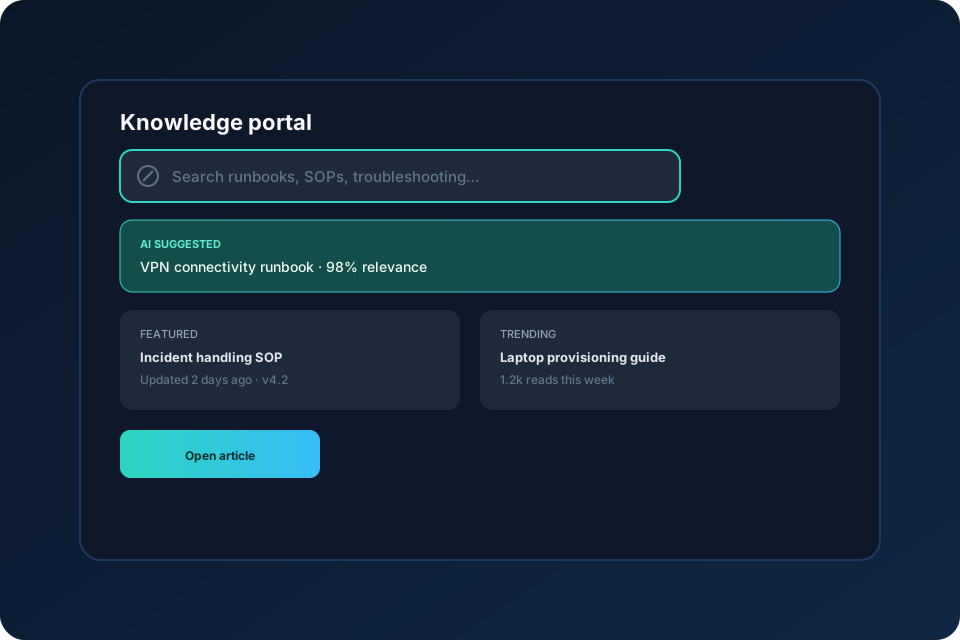
Strategic positioning
Orqit's Knowledge Base fuses structured content with operational intelligence, turning static articles into actionable, context-aware resources that evolve based on real-world usage.
Who this is for
- Support engineers and Tier-2/Tier-3 staff
- End-users seeking self-service resolutions
- Documentation managers maintaining SOPs and runbooks
Operational pain points
-
Scattered documentation Duplicated effort across wikis, drives, and email attachments.
-
Out-of-date SOPs Stale runbooks lead to inconsistent incident handling.
-
Poor searchability Legacy knowledge stores hide answers behind weak keyword search.
-
No incident linkage Articles disconnected from ticket outcomes and resolution data.
Execution-aware ITSM
See the full impact chain—not just the symptom
Authors create markdown or rich-text articles within Orqit. AI indexes content, scores relevance, and surfaces dynamic snippets directly within the ticket interface. Usage analytics feed back into the KB, prompting updates where resolutions diverge from existing guidance.

Capabilities
Platform capabilities
Living operational documentation for support engineers, self-service users, and documentation managers maintaining SOPs and runbooks.
Rich Authoring Suite
WYSIWYG editor with version control and governed publishing.
AI-Powered Search
Semantic query handling across all knowledge assets.
Contextual Article Embedding
Relevant snippets appear in incident and request views.
Usage Analytics
Heat-maps of reads and feedback loops for continuous improvement.
Governance Workflow
Approval gates for publishing with audit trails for compliance.
Workflow examples
How incidents move through Orqit
-
1
Create Article
Support engineer drafts a runbook for a known issue with templates and markdown.
-
2
Publish with Approval
Manager reviews and signs off via the approval workflow.
-
3
Incident Linkage
Article tags attach to related incident types and catalog items.
-
4
AI Suggests
During a new ticket, AI surfaces the article automatically in context.
-
5
Feedback Loop
Users rate relevance; AI updates ranking based on real outcomes.
Operational benefits
Outcomes your teams will feel
Faster resolution
Measurable reduction in handle time for knowledge-backed tickets.
Better self-service
Employees deflect tickets with curated, searchable guidance.
Continuous improvement
Documentation evolves with usage—not annual review cycles only.
Audit-ready history
Version history satisfies regulatory and internal compliance needs.
Governance & security
Built for audit and least-privilege
- Access controls enforce read/write permissions per department and team.
- All edits are recorded in an immutable audit log with digital signatures.
- Content can be encrypted for high-sensitivity SOPs.
AI usage
Co-pilot within your guardrails
AI extracts key steps, creates summary cards, and matches article relevance to ticket context, improving discoverability without exposing raw content outside the tenant VPC.
Analytics visibility
Operational dashboards that executives trust
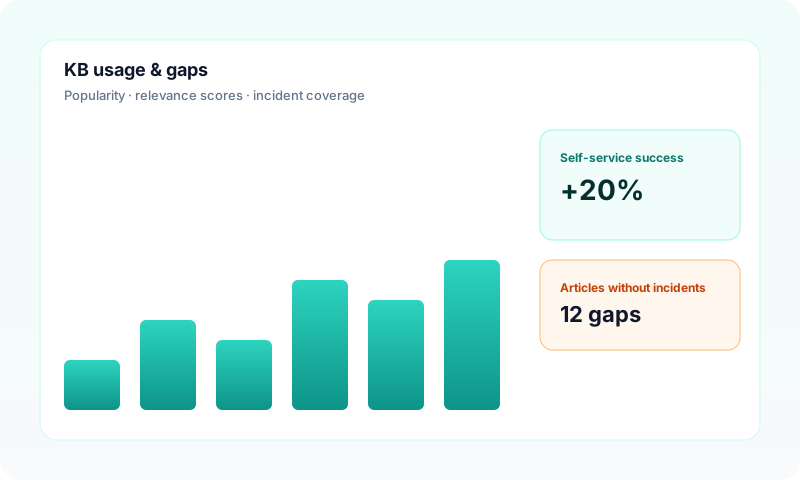
Dashboards display article popularity, relevance scores, and gaps where incidents lack associated KB content.
Integrations
Connects to your stack
Confluence
 Microsoft SharePoint
ITSM tickets
REST API
FAQ
Common questions
Can the KB be scoped to specific teams?
Yes – granular permissions allow team-level knowledge silos with optional cross-team sharing.
How does AI protect confidential procedural data?
AI models operate on encrypted data within the tenant VPC; raw content never leaves the secure environment.
Ready to modernize IT operations?
Launch a pilot workspace or book a walkthrough with our team.