AI Workflows
Intelligent flows that learn and adapt
Add AI decision points to any workflow and let the platform improve over time.
Strategic positioning
Orqit's AI Workflows turn traditional orchestration into a self-optimizing engine, where AI continuously learns from execution data, suggests new branches, and predicts outcomes, while preserving full governance.
Who this is for
- Process engineers designing complex service flows
- IT leaders seeking to embed AI decision points
- Developers integrating custom services into orchestration
Operational pain points
-
Static workflows Flows struggle to adapt when conditions change in production.
-
Manual branch tuning Hand-edited logic leads to errors and slow iteration cycles.
-
Limited performance insight Bottlenecks stay hidden without execution intelligence.
-
Custom prediction code Embedding predictive decisions requires bespoke development.
Execution-aware ITSM
See the full impact chain—not just the symptom
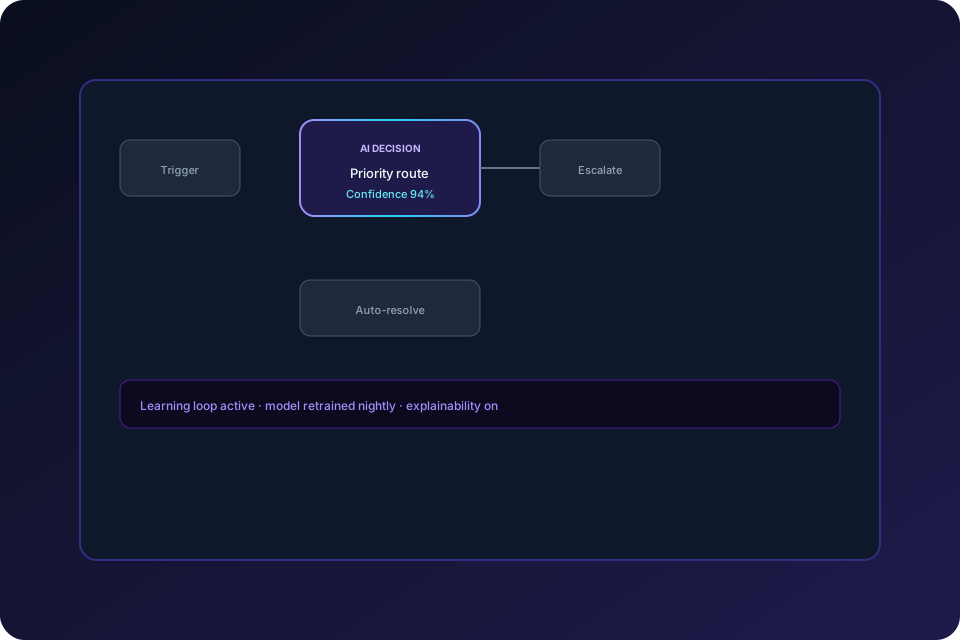
Users design a workflow in the visual builder and add AI Decision Nodes that evaluate real-time data (e.g., incident severity, asset health). The AI model predicts the best path, auto-adjusts thresholds, and surfaces confidence scores. Over time, the system refines predictions based on actual outcomes, feeding back into the model.
Capabilities
Platform capabilities
Self-optimizing orchestration for process engineers, IT leaders embedding AI decision points, and developers integrating custom services.
AI Decision Nodes
Embed probabilistic logic with confidence levels at any step.
Continuous Learning Loop
Models retrain on execution outcomes—nightly by default.
Explainability Dashboard
See why the AI chose a path with feature importance traces.
Policy Guardrails
Enforce compliance before AI-driven actions execute.
Versioned Workflows
Immutable history of flow changes with diff view.
Workflow examples
How incidents move through Orqit
-
1
Incident Prioritization
AI assesses impact metrics, auto-assigns priority, and selects the routing path.
-
2
Change Management
AI predicts change risk from historical success and suggests rollback steps.
-
3
License Procurement
AI evaluates usage trends and recommends bulk vs. per-seat licensing.
-
4
Security Response
AI decides whether to auto-quarantine a host or trigger manual review.
Operational benefits
Outcomes your teams will feel
Faster decisions
Reduce manual decision latency with predictive routing.
Higher success rates
Workflows complete more often on the first optimal path.
Transparent AI
Explainability improves trust and auditability for stakeholders.
Continuous optimization
Execution time improves as the model learns from real runs.
Governance & security
Built for audit and least-privilege
- AI decisions are logged with input data and confidence scores.
- Approval gates can require human sign-off for high-risk paths.
- All model inference occurs within the tenant VPC; data never leaves.
AI usage
Co-pilot within your guardrails
The core AI model evaluates real-time context, predicts outcomes, and suggests optimal branches, learning from each execution.
Analytics visibility
Operational dashboards that executives trust
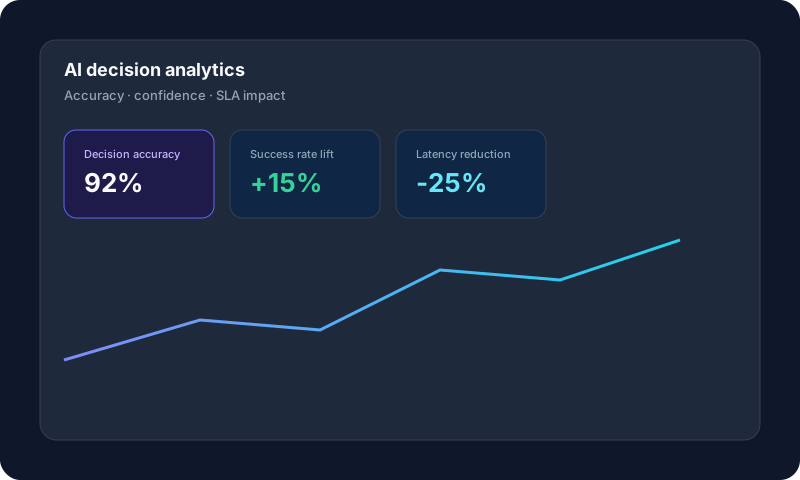
Dashboards show decision accuracy, confidence distribution, and impact on SLA compliance.
Integrations
Connects to your stack
ITSM incidents
Asset Management
 Jira
Jira
 ServiceNow
Custom API actions
FAQ
Common questions
Can I audit the AI's reasoning?
Yes – the Explainability Dashboard provides feature importance and decision trace.
How often does the model retrain?
Retraining occurs nightly on accumulated execution data.
Ready to modernize IT operations?
Launch a pilot workspace or book a walkthrough with our team.